NanoLuc® Labeling System
Label Antibodies and Other Proteins for Use in ELISA

Catalog Number:
Size
Catalog Number: VB1500
HaloTag®-NanoLuc® Labeling for Bioluminescent Signal-Based ELISA
The NanoLuc® Labeling System is based on NanoLuc® luciferase, which is a small (19.1kDa), stable reporter enzyme that generates a bright luminescence signal. Using the NanoLuc® Labeling System, antibodies are chemically labeled with NanoLuc to be used in direct, competition and indirect immunoassays.
HaloTag® technology is used to label antibodies with NanoLuc® luciferase. HaloTag is a fusion protein that covalently binds its ligand (HaloTag® Ligand) under physiological conditions and has been used in variety of applications, including antibody labeling. Labeling is a two-step process in which amine-reactive HaloTag® Succinimidyl Ester (O4) Ligand (509Da) reacts with primary amines of lysine amino acids on the antibodies. For this reaction, antibodies should be in an amine-free buffer without any protein preservative.
Labeling Antibodies with NanoLuc® Luciferase
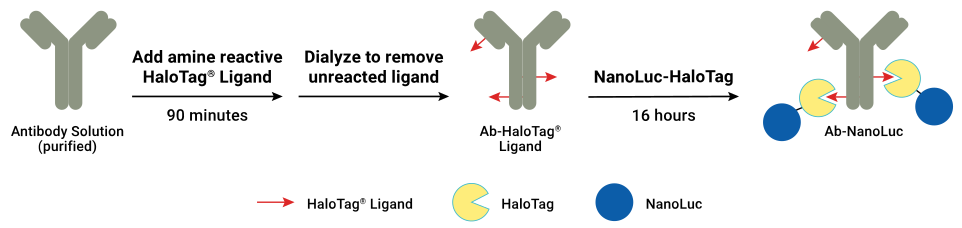
The process for labeling antibodies with NanoLuc-HaloTag can also be used to label other proteins.
ELISA Data Using NanoLuc-Labeled Antibodies
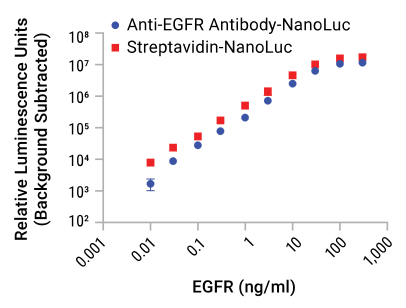
Direct ELISA using anti-EGFR antibody labeled with NanoLuc® luciferase (blue circles) and indirect ELISA using anti-EGFR antibody labeled with biotin in combination with streptavidin-labeled NanoLuc® luciferase (red squares).
Bioluminescence Resource Center
Learn more about how luminescence works, what makes it different from fluorescence and how you can use luminescence to fuel your own research.
Protocols
Complete Protocol
Specifications
Catalog Number:
What's in the box?
| Item | Part # | Size | Concentration |
|---|---|---|---|
IGEPAL® CA-630 |
VB141A | 1 × 100μl | |
HaloTag® Ligand |
VB125A | 1 × 20μl | 20mM |
NanoLuc-HaloTag |
VB131A | 1 × 350μl | 20μM |
SDS
Search for SDSCertificate of Analysis
Use Restrictions
For Research Use Only. Not for Use in Diagnostic Procedures.Storage Conditions
NanoLuc® Labeling System Limited Use Label License
BY USE OF THIS PRODUCT, RESEARCHER AGREES TO BE BOUND BY THE TERMS OF THIS LIMITED USE LABEL LICENSE. If researcher is not willing to accept the terms of this label license, and the product is unused, Promega will accept return of the unused product and provide researcher with a full refund.
Researcher may use this product for research use only and may link NanoLuc®-HaloTag® fusion proteins to researcher-supplied moieties. No transfer or commercial use of this product or derivatives is allowed. Commercial use means any and all uses of this product or derivatives by a party in exchange for consideration, including, but not limited to (1) use in further product manufacture; and (2) resale of the product or its derivatives, whether or not such product or derivatives are resold for use in research. Notwithstanding the foregoing, researcher may use this product or derivatives in provision of services, information or data to third parties in exchange for consideration, provided that researcher does not transfer the product or derivatives. No other use of this product or its derivatives is authorized without the prior express written consent of Promega.
In addition, researcher must either:
(i) use Lumit®-branded luminescent assay reagents (LARs) for all determinations of luminescence activity of this product and its derivatives; or
(ii) contact Promega to obtain a license for use of the product and its derivatives with LARs not manufactured by Promega.
With respect to any uses outside this label license, including any diagnostic, therapeutic, prophylactic or commercial uses, please contact Promega for supply and licensing information. PROMEGA MAKES NO REPRESENTATIONS OR WARRANTIES OF ANY KIND, EITHER EXPRESSED OR IMPLIED, INCLUDING FOR MERCHANTABILITY OR FITNESS FOR A PARTICULAR PURPOSE, WITH REGARD TO THE PRODUCT. The terms of this label license shall be governed under the laws of the State of Wisconsin, USA.
U.S. Pat. No. 9,540,402, European Pat. No. 2369006, Japanese Pat. No. 474868 and other patents.
U.S. Pat. Nos. 9,873,866 and 10,246,690; European Pat. Nos. 2341134, 2374875, 2395078, 2492342 and 2502990; Japanese Pat. Nos. 5680302 and 5840117 and other patents.
U.S. Pat. No. 10,233,485 and 10,774,364; European Pat. Nos. 2990478 and 3498710; Japanese Pat. No. 6539689; and other patents and patents pending.