Promega Art Contest for Creative Scientists
FINALISTS OF THE 2021 COMPETITION
JURY AWARDS
In 2021, the first edition of the Art + Science Contest took place. The ten thought-provoking artworks that made it to the collection, including the winner and runner-ups, are exhibited here for your delight. Enjoy them and the explanations that go along with each art piece.
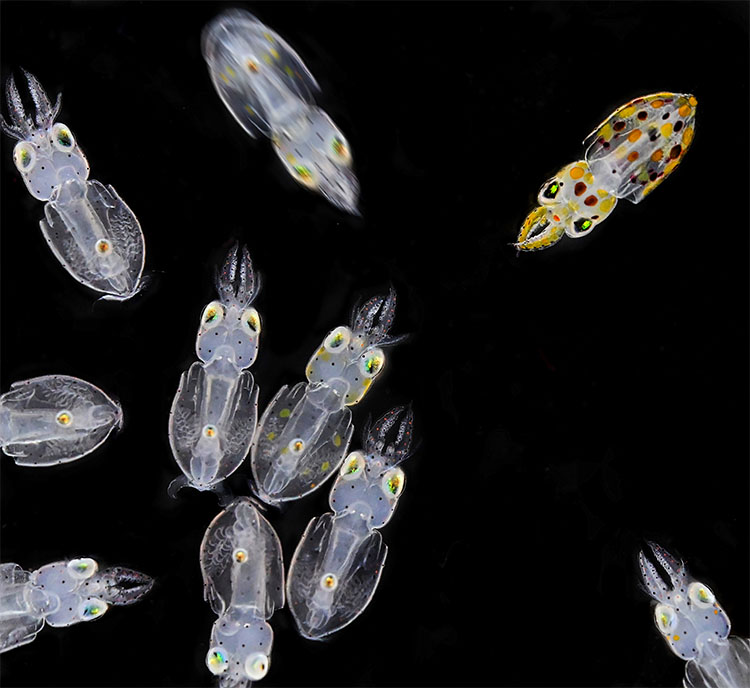
ONE OUT (Winner)
Urs Albrecht | University of Fribourg
The common squid babies (loligo vulgaris) have the potential to change color to communicate with each other. This picture shows one squid in the upper right corner feeling quite different from the rest of the group. Is it afraid? Is it belligerent? We don’t know. Maybe the blurred moving squid is mediating. Social communication and behaviors among baby squids are comparable to human social interaction and the picture has an unforeseen sad actuality.
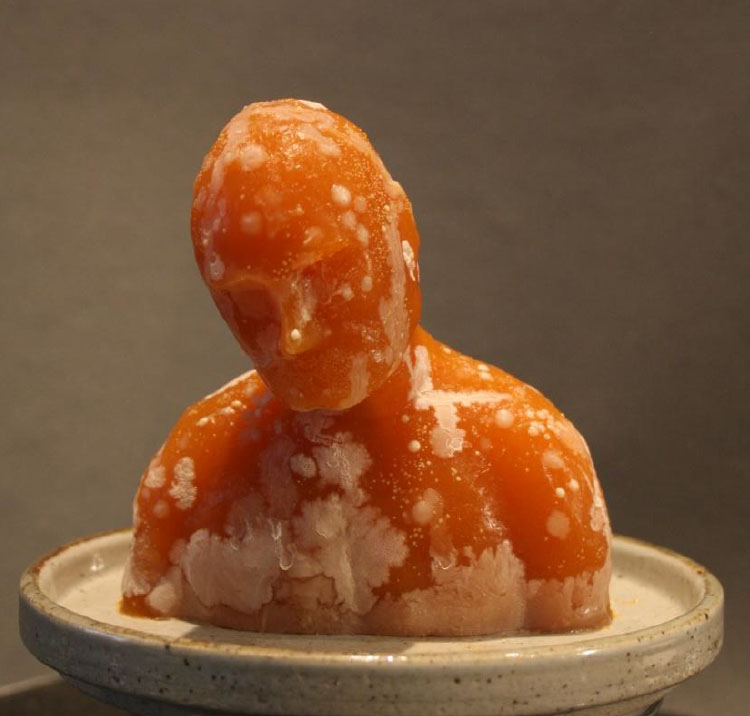
ON MY SKIN (Second Place)
Estevao A Peroza | ETH Zürich
This artwork explores the existential relations between living beings and the system they live in. It is a quest to “visualize” what lies beyond our perception. Estevao A Peroza gives a representation of the life forms that live on the surface of his body. He makes visible the micro-flora that habits on his skin. Their relationship finds parallels with the relationship between humans and our planet. Our condition and fate on earth are determined and modulated by what the planet does or does not provide us.
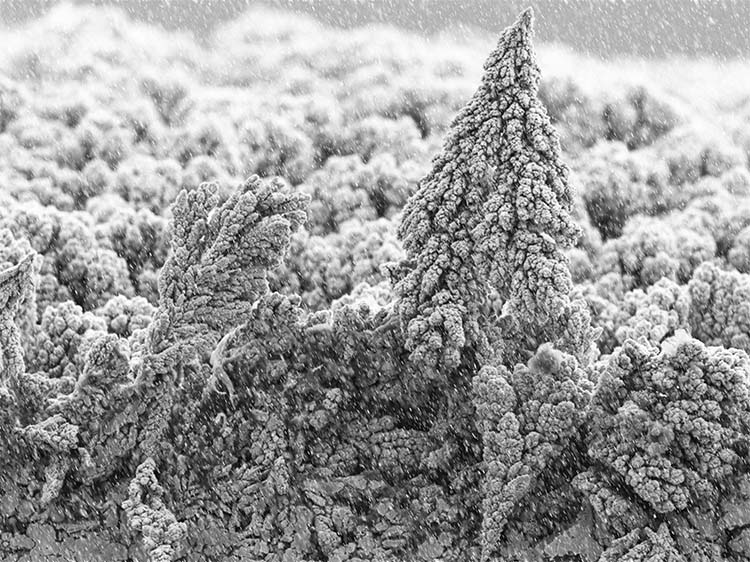
THE SNOW FOREST (Third Place & Promega Team's Choice)
Anna Iarchuk | University of Bern
The picture taken in December shows the nanoscale structures hiding inside a porous nickel foam. In true holiday season spirit, the agglomeration of the nickel nanoparticles looks like a Christmas tree, reminding us that nature creates the most amazing things. We are simply to appreciate them. This artwork illustrates that fascinating things are always hidden, and to uncover something, one must always look deeper.
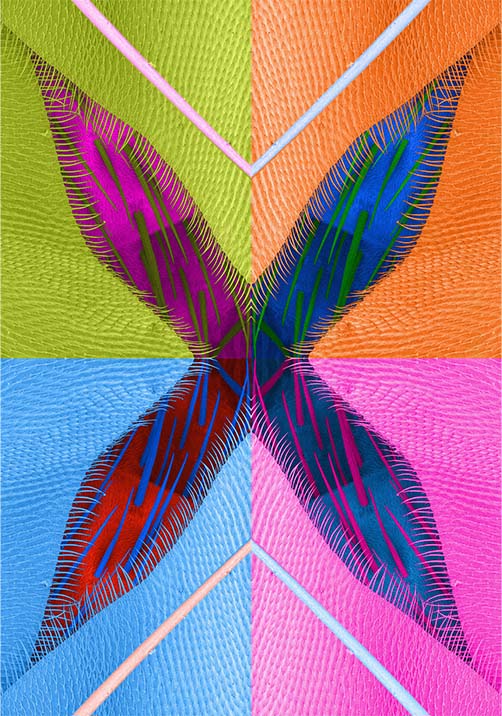
WINGS TO FLY
Stefan Meichtry & Langley Anderson | KissedByElectrons.com
#HairyTheFly - Ping-Pong and poetry between art and science: Langley Anderson collaborated on this artwork with Stefan Meichtry, a Swiss chemical engineer. The latter provided scanning electron micrographs of a fly coated with gold and Langley Anderson digitally enhanced these images. The colors were carefully chosen due to Stefan's red-green deficiency. (The fly received a name and Stefan wrote a poem about it, linking the charging problem of scanning electron microscopy with Greek mythology.)
CODEX TRYPANOSOMA
André Schneider | University of Bern
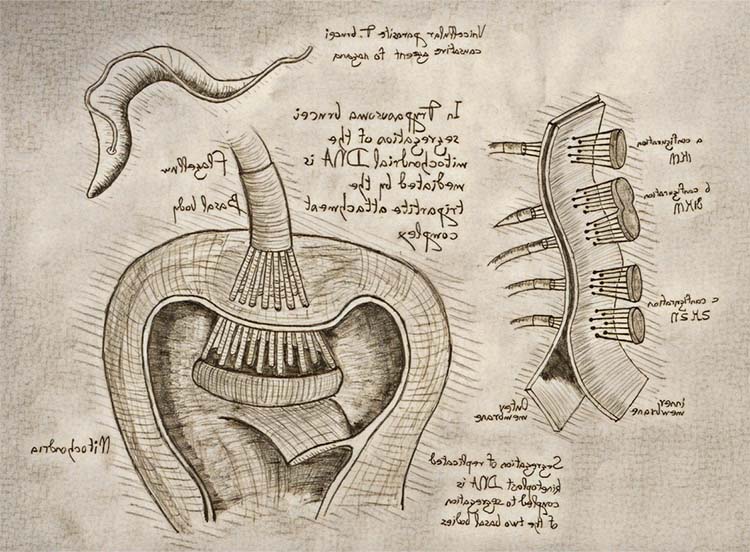
This drawing presents the unicellular parasite Trypanosoma brucei. It also depicts the architecture of the “tripartite attachment complex” (TAC) that connects the mitochondrial genome with the flagellum and how the TAC functions during cell division. This work was inspired by Leonardo da Vinci, the archetypical science artist. The text mimics the mirror hand-writing da Vinci used in his anatomical and technical drawings.
ECLIPSE IN A PETRI DISH
Estelle Pignon | University of Lausanne
ENCOUNTER OF MICRO AND MACRO WORLDS
Ester Piovesana | University of Southern Switzerland
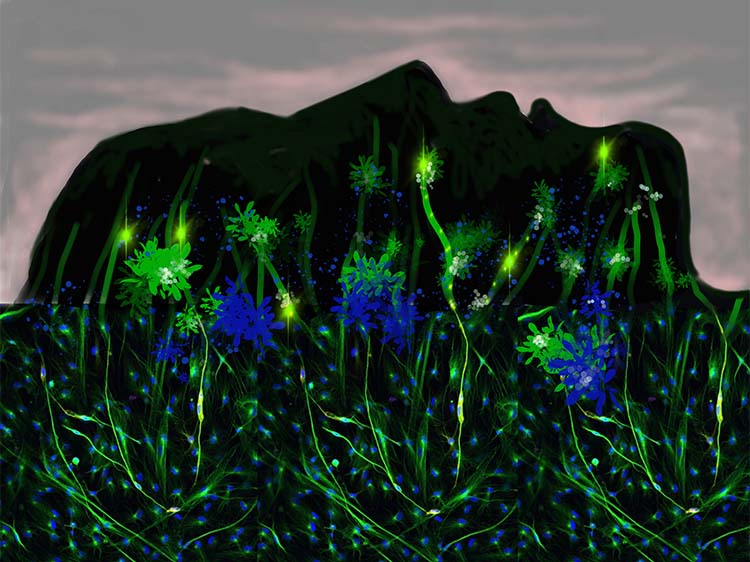
This artwork results from a collaboration between a scientist and an artist describing the coexistence of macro and microbiology. It incorporates the different scales of biology in a single vision using different techniques ranging from confocal images to digital art. Induced neurons are transformed in flowers on a mountainous landscape, reminding us of a head profile that recalls these cells' natural origin: the brain.
MACROSCOPY UNDER THE MICROSCOPE
Charline Carron | University of Lausanne
ALIEN
Alexandros Kanellopoulos | University of Lausanne
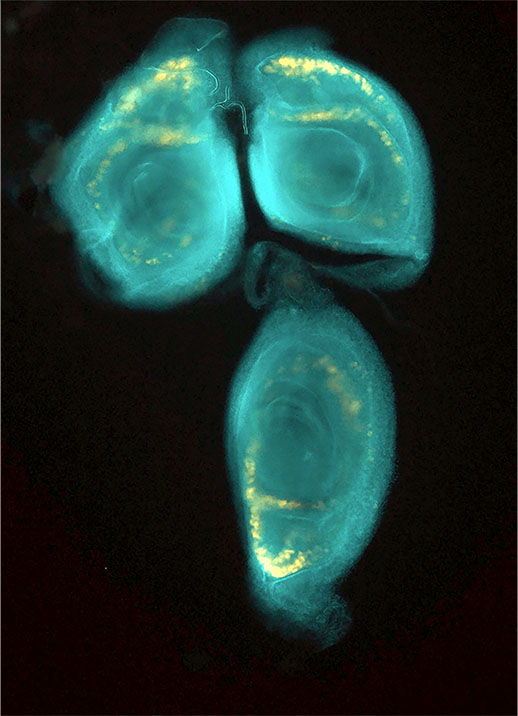
Imaginal discs are sac-like epithelial structures found inside fruit flies (Drosophila melanogaster) larvae. During metamorphosis, almost all the larval tissues degenerate, and the imaginal discs turn into the external structures of the head, thorax, limbs, and genitalia. Metamorphosis is a unique life cycle and it is akin to the beautiful process of reinventing oneself. The image was acquired with confocal imaging upon immunohistochemistry of specific protein markers of the imaginal discs.
WANNA FIGHT?
Sara Heim | University of Lausanne
SELECTED GUEST ARTWORK
This section showcases the best artwork selected from submissions out of competition.
CRYSTALLINE UNIVERSE
Paula Scanavez Ferreira | Federal University of São Paulo
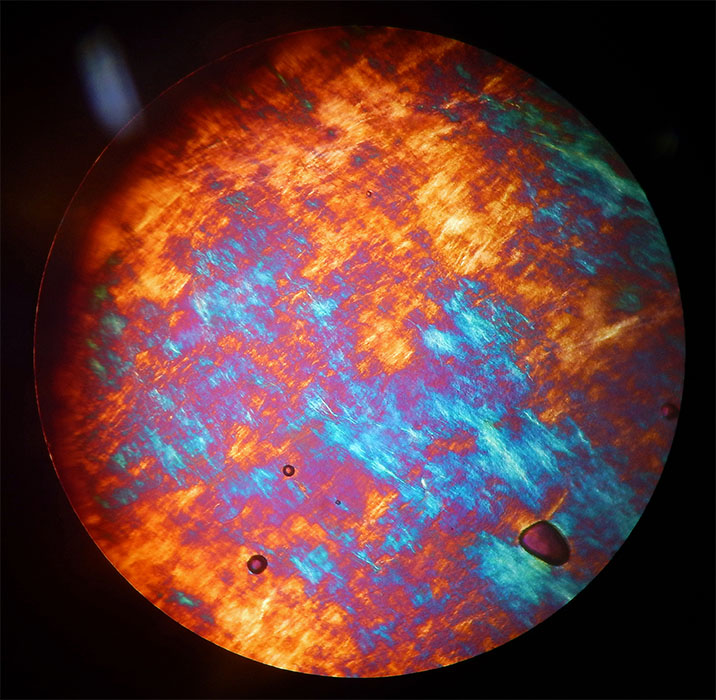
The Crystalline Universe picture shows liquid crystals developed as drug delivery systems. They were visualized under polarized light microscopy (PLM) to identify their mesophase. Liquid crystals have three known mesophases, of which some can show anisotropy. Under PLM, this anisotropy causes them to exhibit birefringence, revealing striking patterns and color effects. That's the reason behind the artwork's name: it looks like a picture of a planet or a beautiful galaxy.
CHILDREN ART
One is never too young to be an artist or a scientist. This section is dedicated to the contribution of the children attending the Craft Room Liestal. They observed some microorganisms with a microscope and made illustrations with aquarelle.
Interview
Interview with the winner of the 2021 edition Urs Albrecht.
How did you become interested in squids as an experimental model?
My lab works mainly with mice. Other professors work with different organisms such as drosophila, C. elegans, plants, and yeast at our university. One of them, Simon Sprecher, became interested in marine biology and started a course for students. I immediately thought that's a great idea because it is something different, and few actually look deeply into the biology of marine organisms. The literature on squids is scarce and old, and they are challenging to keep in lab conditions. Yet, my colleague ordered Loligo Vulgaris eggs from Villefranche Sur Mer in France and started establishing them to hatch and grow in Fribourg. He was successful. The next step was setting up experimentation. However, squids have brains, and to carry out experiments with them, we needed to apply for authorization from the Swiss Government. I helped out, but it was challenging because there were no standards and regulations, as nobody works on these animals in Switzerland. Now we are interested in studying the communication between squids. It is easy to observe how they change color, because they are transparent. The change in color is related to their stress level and mood.
What went into taking the image that is "One Out."
I've been a hobby photographer since I am ten years old. So when I went to my colleague's lab and looked at the baby squids, I said, "Ohh, they are beautiful." They looked really stunning, and some of them started changing colors in front of me. I thought that was a fascinating behavior, and I wanted to capture that.
Baby squids are transparent and colorful. I had to think about how I could best picture them. I decided to have them in a Petri dish and put them on a stand with lighting coming from below on a black background. I made several images. On one of them, there was this situation where one of the squids was changing color. It was very different from all the others. It immediately came to my mind that something was happening. They were communicating.
What prompted you to participate in the Science + Art competition?
I think that it is a general human urge to share how you see the world. And because you're interacting with others, you can get a measure of whether they see it the same way or not. It's always risky because people can love it or hate it. It is then your choice to rationally analyze why somebody likes something or not and gain experience from it.
To you, how are art and science different?
Science is rational. It is based on investigations to link information together. Art is the exact opposite. It's irrational as it is about feelings and emotions aroused by what you sense. Yet, both science and art are driven by interpretation. In science, you obtain analytical results and interpret them using your imagination as well. Whereas in art, it is the other way around. You first make an interpretation, and then you start capturing it with a rational machine (e.g., a camera or a pen). Art and science are the two poles of a similar creative process.
What do you want people to think when looking at "One Out"?
"One Out" shows two different groups, with one individual being in the minority, maybe scared or angry for some unknown reason. I took the picture because I thought this happens in our societies as well. Fate had it that some weeks later, war broke out in Ukraine. The important message to me is that we humans behave similarly to "simpler" animals - they are really not that simple. So, humans must be humbler towards nature when looking at it because although we always say we are better, we are not. We are very similar and not much different.
There is this push to reduce animal experimentation and use more cell-based systems. What do you think of this development, and do you believe that we will be able to do only animal-free experiments one day?
Doing exclusively animal-free experimentation would mean ignoring certain aspects such as communication within the system one is studying. This is not desirable in science and research. Studying cells doesn't allow you to draw conclusions about an entire organism's functioning. Let's take the example of depression, which manifests the communication between brain cells. If you study neurons or only the brain, you cannot understand depression entirely because cells don't show behavior. Of course, there is a need to control how people experiment with animals to avoid abuse. Whenever conducting experiments on animals, we must be responsible, avoid unnecessary suffering and behave ethically. Unfortunately, regardless of all the rules we set, there will always be a minority that will break them.
Winners will be announced February 2022 on this page.
-
Eligibility
The Promega AG Art Contest for Creative Scientists (the “Art Contest”) is open to scientists who are at least 18 years old and live in Switzerland. The Art Contest is limited to one entry per person. All Art Contest submissions must be submitted in a digital format using the online entry form.
-
Entry
As an eligible scientist, you must complete the entry form on this website and upload a digital image of your Art Contest submission prior to January 15, 2022 11:59 pm Zurich time (the “Deadline”). The digital images can be submitted in PNG or TIFF format with maximum size of 10MB with the highest resolution possible (not up-RESed). Digital touch ups are permitted. Only the first digital image submitted by you by the Deadline with a completed entry form will be entered into the Art Contest (“Art Submission”). No Art Submissions will be accepted after the Deadline. You must provide a valid email address as part of your entry form.
Please consider that your organization’s internal policy may not allow you to receive prizes or may require your employer’s permission before you submit an entry into the contest. You are solely responsible for compliance with your employer’s policies.
Employees of Promega AG and their immediate family members (spouses, parents, children, siblings and their respective spouses, regardless of where they live) are not eligible to enter the Art Contest.
-
Prizes
All Art Submissions will be reviewed by a panel of judges and a collection (“Art Collection”) will be created out of selected Art Submissions (that become “Art Images”). A grand prize winner and two runners-up will be selected within the Art Collection. The grand prize winner will receive a special recognition trophy designed by Martin Oeggerli and have his/her work displayed in an art exhibition organized by Figure 1A in 2022. The grand prize winner and the two runners-up will receive winners’ certificates and dedicated copies of the album “Micronavigating Between Art and Science” by Martin Oeggerli. The Art Collection will be presented in a virtual exhibition on Promega.com.
-
Additional Terms
By participating, you warrant that all information provided is accurate, that you are the lawful owner of all intellectual property associated with your Art Submission, and that your participation in the Art Contest does not violate any applicable laws or regulations. Promega AG reserves the right to request proof that your Art Submission and/or Art Image is your original artwork created solely by you. Non-compliance with this rule may disqualify you from the Art Contest.
By participating, all entry information submitted by you as part of the Art Submission becomes property of Promega AG. You retain title and ownership of the Art Submission and/or Art Image but hereby grant Promega AG a non-exclusive license, irrevocable, royalty-free license to use the Art Image as described herein and to reproduce images of the Art Image in association with display, advertising, promotion, and/or marketing of the Promega AG art exhibition, at Promega’s discretion.
No prize transfer or cash redemption is permitted. No prize substitution is permitted, except by the sole discretion of Promega AG, in which case a prize of comparable or greater value will be awarded. You are solely responsible for paying all federal, cantonal, and local taxes on any prizes.
By participating, you agree to abide by and be bound by the rules and decisions of Promega AG which shall be final in all respects relating to this Art Contest, including without limitation to the interpretation of these rules. You agree to release, discharge and hold harmless Promega AG, affiliates, and their officers, directors, agents and representatives and their respective employees from any and all claims, charges, injuries, liability, losses and/or damages of any kind resulting from or arising out of your participation in the Art Contest, your violation of any third-party rights, and/or your acceptance, use, misuse or possession of any prize received through the Art Contest. Promega AG affiliates, and their officers, directors, agents and representatives and their respective employees are not responsible and shall not be liable for: (a) late entries for any reason; (b) any disruption, delay, modification, or discontinuance of the Art Contest and/or your Art Submission; or (c) your participation in the Art Contest. Promega makes no warranties of any kind in association with the Art Contest.
If, for any reason, the Art Contest is not capable of running as planned, because of causes beyond the control of Promega AG, Promega AG reserves the right, in its sole discretion, to cancel, terminate, modify, or suspend the contest.
Meet the Jury
Dr. Joanna Stevenson
Head of Marketing at Promega Switzerland, Knitwear designer and multi-crafter
Dr. Martin Oeggerli
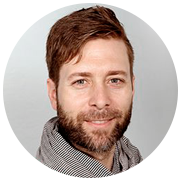
Swiss photographer specializing in scientific microscopy and fine art
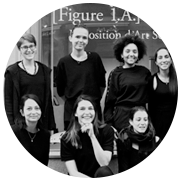
Figure 1.A.
Scientist and artist collective organizing The Scientific Art Exhibition