Kinase-Glo® Luminescent Kinase Assays


Monitors Activity of Purified Kinases by Quantifying ATP
- Luminescent signal is inversely proportional to the amount of kinase activity
- Three kit formats: Linear to 10μM (Kinase-Glo®); 100μM (Kinase-Glo® Plus) or 500μM (Kinase-Glo® Max) ATP

Catalog Number:
Size
Choose a product
Catalog Number: V6711
Catalog Number: V6712
Catalog Number: V6713
Catalog Number: V6714
Catalog Number: V6071
Catalog Number: V6072
Catalog Number: V6073
Catalog Number: V6074
Catalog Number: V3771
Catalog Number: V3772
Catalog Number: V3773
Catalog Number: V3774
Luminescent, High-Throughput Kinase Activity Assays
Simple, Scalable and Automation-Friendly
The Kinase-Glo® Assays are designed for use with multiwell plate formats, making them ideal for automated high-throughput screening (HTS), and they can be used to assay protein, lipid and sugar kinases. The assay procedure involves addition of a single reagent directly to a completed kinase reaction. This addition results in the generation of a luminescent signal correlated with the amount of ATP present and inversely proportional to the amount of kinase activity.
The assay produces excellent Z´-factor values of greater than 0.7 in 96- and 384-well formats, easily detects known kinase inhibitors and provides IC50 values comparable to those reported in the literature.
Choose Your Assay Format
The three Kinase-Glo® Assay systems are differentiated by their linear response to ATP. The original Kinase-Glo® Assay is linear to 10μM ATP, while Kinase-Glo® Plus Assay is linear to 100μM ATP. The newest assay, Kinase-Glo® Max, is linear to 500μM ATP, making it well suited for use with kinases with high Km for ATP as well as for screening for kinase inhibitors that do not compete at the ATP binding site.
Luminescent output correlates with amount of ATP. A direct relationship exists between the luminescence measured with the Kinase-Glo® Assays and the amount of ATP in the reaction. Panel A. Kinase-Glo® Plus Assay. Panel B. Kinase-Glo® Max Assay. The Kinase-Glo® Assay is linear to 10µM (data not shown).
Protocols
Specifications
Catalog Number:
What's in the box?
| Item | Part # | Size |
|---|---|---|
|
Kinase-Glo® Substrate |
V672A | 1 × 1 vial |
|
Kinase-Glo® Buffer |
V673A | 1 × 10ml |
SDS
Search for SDSCertificate of Analysis
Use Restrictions
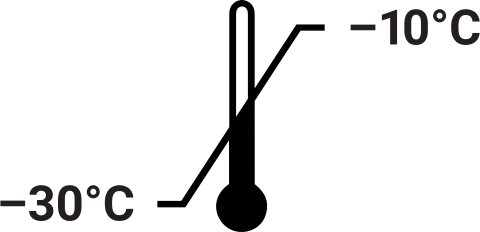
For Research Use Only. Not for Use in Diagnostic Procedures.Storage Conditions
U.S. Pat. No. 7,700,310 and other patents and patents pending.
What's in the box?
| Item | Part # | Size |
|---|---|---|
|
Kinase-Glo® Substrate |
V672A | 10 × 1 vial |
|
Kinase-Glo® Buffer |
V673A | 10 × 10ml |
SDS
Search for SDSCertificate of Analysis
Use Restrictions
For Research Use Only. Not for Use in Diagnostic Procedures.Storage Conditions
U.S. Pat. No. 7,700,310 and other patents and patents pending.
What's in the box?
| Item | Part # | Size |
|---|---|---|
|
Kinase-Glo® Substrate |
V672B | 1 × 1 vial |
|
Kinase-Glo® Buffer |
V673B | 1 × 100ml |
SDS
Search for SDSCertificate of Analysis
Use Restrictions
For Research Use Only. Not for Use in Diagnostic Procedures.Storage Conditions
U.S. Pat. No. 7,700,310 and other patents and patents pending.
What's in the box?
| Item | Part # | Size |
|---|---|---|
|
Kinase-Glo® Substrate |
V672B | 10 × 1 vial |
|
Kinase-Glo® Buffer |
V673B | 10 × 100ml |
SDS
Search for SDSCertificate of Analysis
Use Restrictions
For Research Use Only. Not for Use in Diagnostic Procedures.Storage Conditions
U.S. Pat. No. 7,700,310 and other patents and patents pending.
What's in the box?
| Item | Part # | Size |
|---|---|---|
|
Kinase-Glo® Max Buffer |
V608A | 1 × 10ml |
|
Kinase-Glo® Max Substrate |
V609A | 1 × Resuspend to 10ml |
SDS
Search for SDSCertificate of Analysis
Use Restrictions
For Research Use Only. Not for Use in Diagnostic Procedures.Storage Conditions
U.S. Pat. No. 7,700,310 and other patents and patents pending.
What's in the box?
| Item | Part # | Size |
|---|---|---|
|
Kinase-Glo® Max Buffer |
V608A | 10 × 10ml |
|
Kinase-Glo® Max Substrate |
V609A | 10 × Resuspend to 10ml |
SDS
Search for SDSCertificate of Analysis
Use Restrictions
For Research Use Only. Not for Use in Diagnostic Procedures.Storage Conditions
U.S. Pat. No. 7,700,310 and other patents and patents pending.
What's in the box?
| Item | Part # | Size |
|---|---|---|
|
Kinase-Glo® Max Buffer |
V608B | 1 × 100ml |
Kinase-Glo® Max Substrate |
V609B | 1 × 1 vial |
SDS
Search for SDSCertificate of Analysis
Use Restrictions
For Research Use Only. Not for Use in Diagnostic Procedures.Storage Conditions
U.S. Pat. No. 7,700,310 and other patents and patents pending.
What's in the box?
| Item | Part # | Size |
|---|---|---|
|
Kinase-Glo® Max Buffer |
V608B | 10 × 100ml |
Kinase-Glo® Max Substrate |
V609B | 10 × 1 vial |
SDS
Search for SDSCertificate of Analysis
Use Restrictions
For Research Use Only. Not for Use in Diagnostic Procedures.Storage Conditions
U.S. Pat. No. 7,700,310 and other patents and patents pending.
What's in the box?
| Item | Part # | Size |
|---|---|---|
|
Kinase-Glo® Plus Substrate |
V378A | 1 × Lyophilized, Resuspend to 10ml |
|
Kinase-Glo® Plus Buffer |
V379A | 1 × 10ml |
SDS
Search for SDSCertificate of Analysis
Use Restrictions
For Research Use Only. Not for Use in Diagnostic Procedures.Storage Conditions
U.S. Pat. No. 7,700,310 and other patents and patents pending.
What's in the box?
| Item | Part # | Size |
|---|---|---|
|
Kinase-Glo® Plus Substrate |
V378A | 10 × Lyophilized, Resuspend to 10ml |
|
Kinase-Glo® Plus Buffer |
V379A | 10 × 10ml |
SDS
Search for SDSCertificate of Analysis
Use Restrictions
For Research Use Only. Not for Use in Diagnostic Procedures.Storage Conditions
U.S. Pat. No. 7,700,310 and other patents and patents pending.
What's in the box?
| Item | Part # | Size |
|---|---|---|
|
Kinase-Glo® Plus Substrate |
V378B | 1 × Lyophilized, Resuspend to 100ml |
|
Kinase-Glo® Plus Buffer |
V379B | 1 × 100ml |
SDS
Search for SDSCertificate of Analysis
Use Restrictions
For Research Use Only. Not for Use in Diagnostic Procedures.Storage Conditions
U.S. Pat. No. 7,700,310 and other patents and patents pending.
What's in the box?
| Item | Part # | Size |
|---|---|---|
|
Kinase-Glo® Plus Substrate |
V378B | 10 × Lyophilized, Resuspend to 100ml |
|
Kinase-Glo® Plus Buffer |
V379B | 10 × 100ml |
SDS
Search for SDSCertificate of Analysis
Use Restrictions
For Research Use Only. Not for Use in Diagnostic Procedures.Storage Conditions
U.S. Pat. No. 7,700,310 and other patents and patents pending.
Resources
No related resources available
